
The Animal Spirit Doctrine and the Origins of Neurophysiology showed the extended nature of the paradigm shift which led to the birth of modern neurophysiology. Julius Bernstein’s electrochemical Membrantheorie is considered one of the pivotal moments, but it was not a simple linear arc. During the late 19th century two opposing theories were proposed to explain the advanced galvanometer readings from nerve and muscle preparations:
- Emil du Bois-Reymond’s molecular theory based on “electromotive particles” (Smith et al., 2012)
- Ludimar Hermann’s alteration theory which attributed the electromotive effects of animal tissues to chemical changes manifested as atrophy and necrosis (De Palma & Pareti, 2011)
Both Hermann and Bernstein were students of du Bois-Reymond and Bernstein criticized Hermann’s term “injury current” or “demarcation current” for the “negative variation” of action potential, because it attached a theory to an experimental observation (De Palma & Pareti, 2011). Bernstein not only invented a novel instrument to capture the timescale of “negative variation”, but also applied nascent ideas from other domains of physical and electrochemistry to build his “pre-existence theory”.
Birth of the Cell Membrane
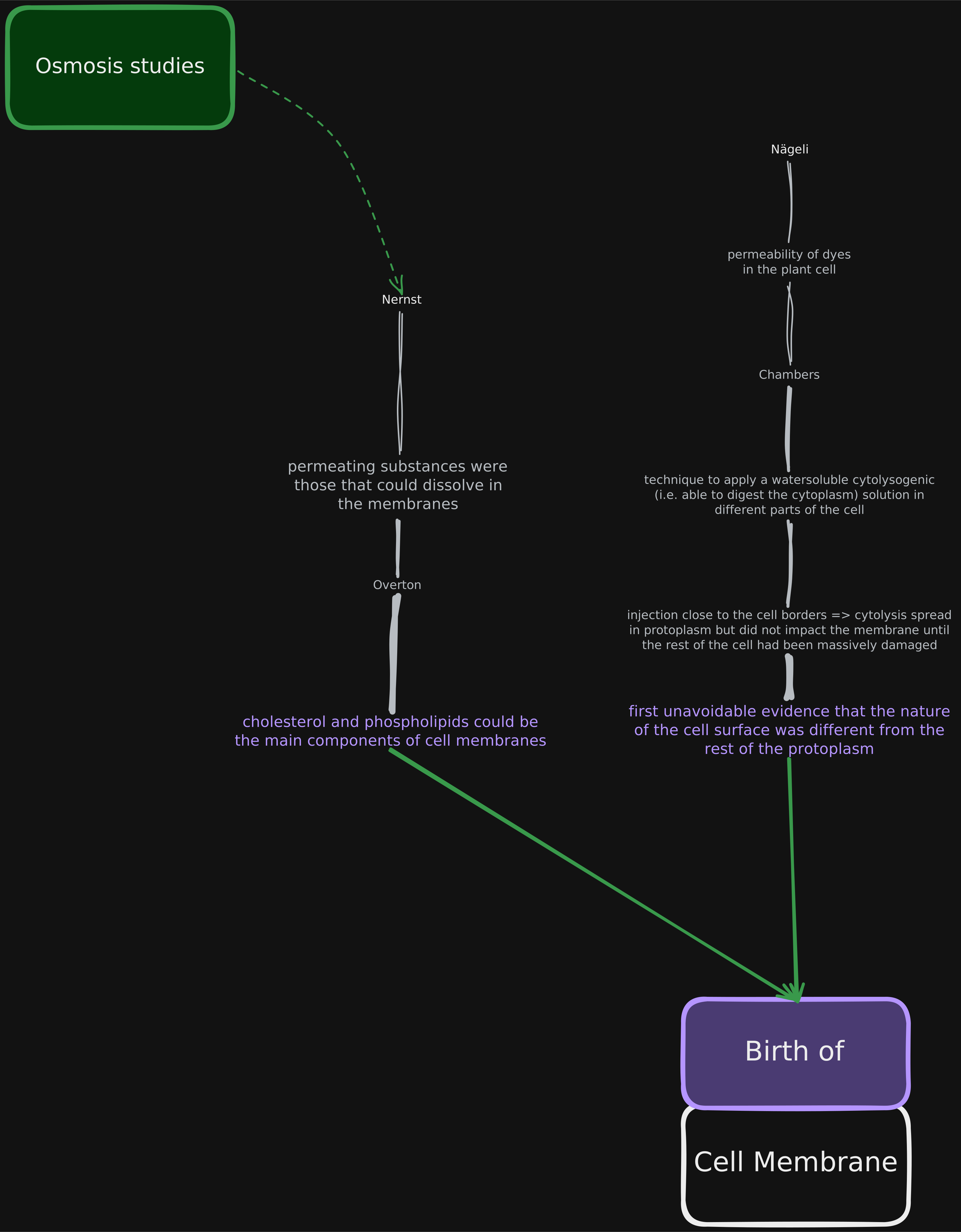
(Lombard, 2014) describes that the final establishment of the cell membrane as a distinct entity from the protoplasm required the convergence of three independent lines of indirect evidence: semi-permeability/solubility, dye/microinjection, and electrophysiology. No visual confirmation was available until the beginning of the 20th century. The above mind map shows the evolution of the other two lines which were available to Bernstein. But the separation between cell membrane and the containing protoplasm was still nascent and around 1890 cell membranes were still considered non-essential (Lombard, 2014).
Birth of Modern Physical Chemistry and Electrochemistry
Following the experiments by Traube and Pfeffer on precipitation membranes which showed a correlation between the osmotic pressure and the solute concentration and temperature (Lombard, 2014), Van’t Hoff experimentally proved that solutes in dilute solutions follow ideal gas laws (Pfeffer, 1899). But he was unable to generalize the law to include electrolytes, since the idea of atoms and ions as particles was not yet widely accepted during this time. In the same journal in which Van’t Hoff published his famous law, Arrhenius’s dissertation on dissociation of substances in water was included by Wilhelm Ostwald as an extension which gave the experimental basis for generalization of Van’t Hoff’s Law (Pfeffer, 1899).
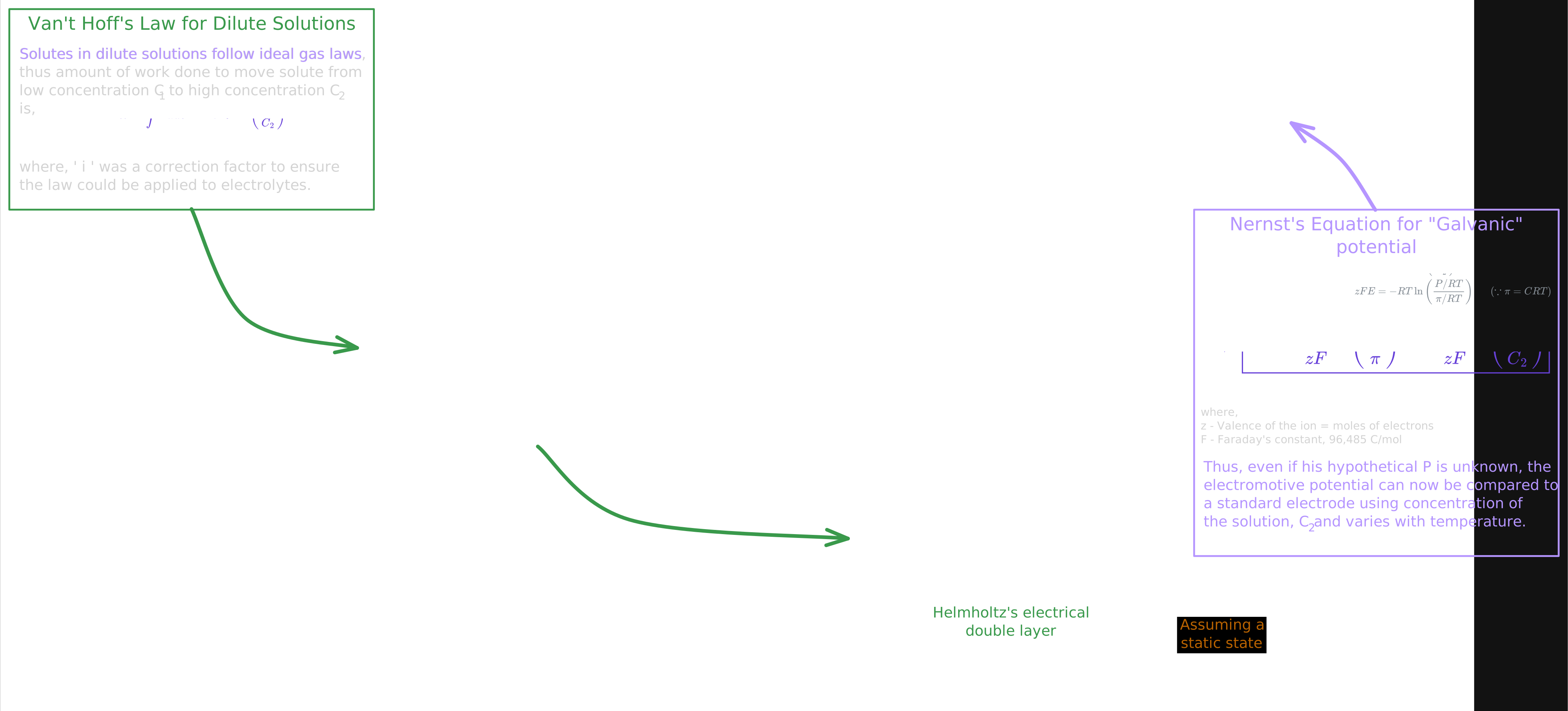
The above diagram shows how Walther Nernst applied various concepts (in green) to derive his famous equation for “Galvanic” potential of an electrochemical cell (Nernst, 1889).
Julius Bernstein
Bernstein’s greatest contributions include,
First description of the “negative variation” of action potential (1868)
- A novel instrument which was able to sample the potential between interior and exterior of a frog muscle or a nerve at various times following stimulation.
- The main mechanism behind the differential rheotome was a turntable which closes the stimulation and recording circuits only for a split second allowing high temporal resolution (“current slicer”). One can imagine controlling the angles at which spokes on this wheel are placed which in turn control the timepoint at which the potential is recorded.
- The temporal description was able to reconcile the “excitatory process”, whose speed was measured by Helmholtz with the “negative variation” measured by du Bois-Reymond.
- Bernstein was also able to capture the “overshoot” of the potential beyond zero for strong stimuli. He was unable to replicate this reliably in muscles. The involvement of ions and the position of the cut surface with respect to the sarcoplasmic reticulum could have been responsible for this finding.
Membrane Theory (1902):
- Living cells contain a selectively permeable membrane separating the interior and exterior electrolytes. Thus, the cell membrane was the hinge for Bernstein’s model, hence the name “Membrane Theory”. Most of the experiments on cell membranes were limited to plant biology at this time.
- The electrolytic solutions are different on both sides, which implies the formation of an electrical double layer across the membrane. Bernstein then applied the concepts of electrochemistry to justify this. He experimentally proved that the measured potential varies linearly with absolute temperature, thereby grounding his theory to Nernst’s equation which was thermodynamically established. Nernst assumed a static state at equilibrium to derive this equation. This assumption became an important detail when succeeding scientists tried to replicate Bernstein’s findings. Thus the electrical separation was already present due to the semi-permeable nature of the membrane, hence the name “pre-existence theory”.
- The semi-permeable nature of the membrane breaks down during activity, which results in the reduction of potential due to the movement of the ions, hence the name “negative variation”.
- Bernstein only considered the movement of ions and chose to leave out his previous result of overshoot in potential beyond zero which he could not replicate reliably in muscles. Leaving out this finding made sense considering the complete breakdown of semi-permeability, since this should result in a zero potential at peak. Another possible reason for this could have been that Nernst’s equation did not include multiple ion concentrations.
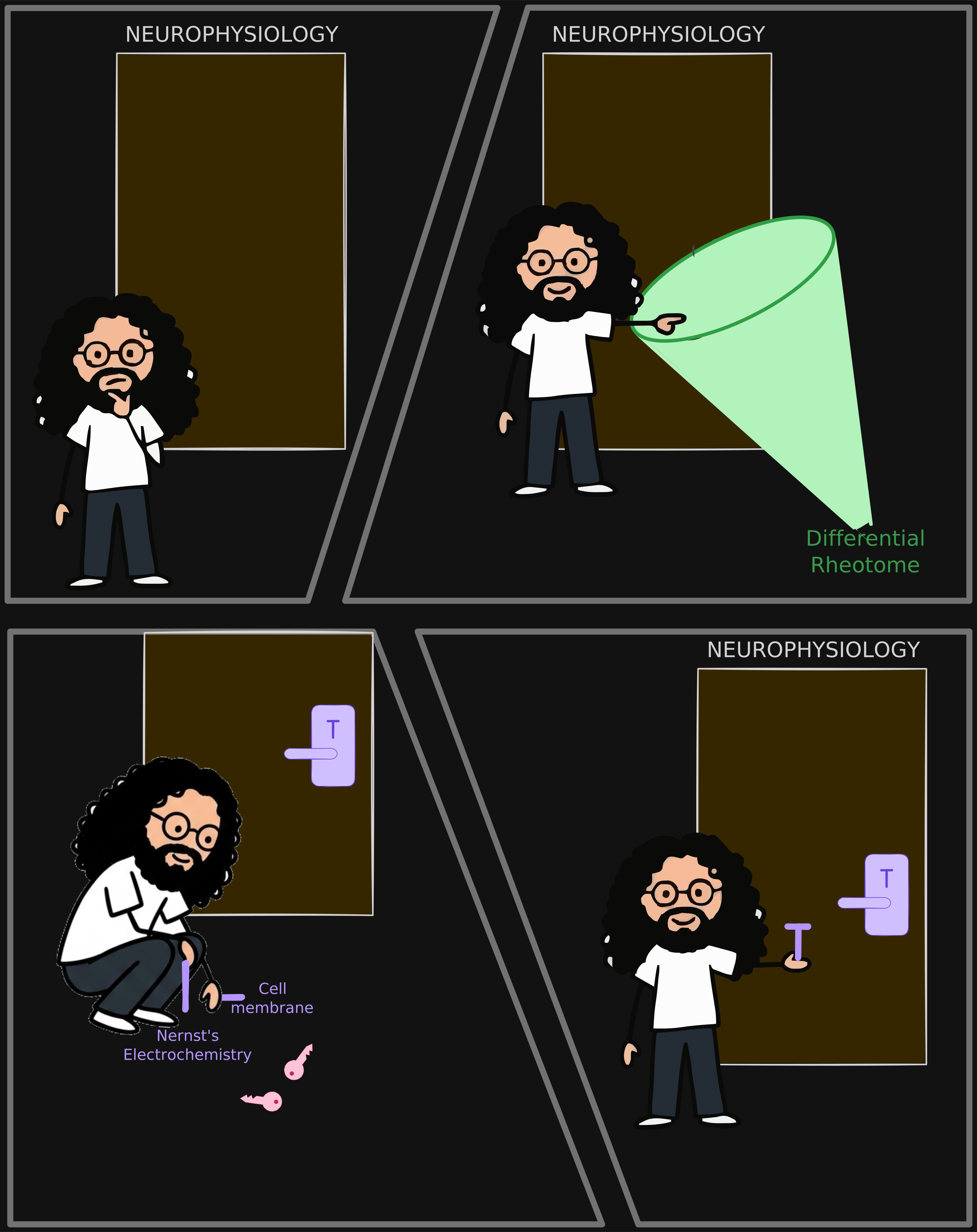
On the surface, this is about Bernstein’s greatest contributions. But at the core, it’s really about how the differential rheotome’s precise description of the bioelectric phenomenon of nerves and muscles created a vacuum, which Bernstein filled by reaching for the concepts of cell membrane and electrochemistry.
I chose to capture Bernstein’s approach using the above comic. The two discoveries are connected in a profound manner. The differential rheotome is the moonlight which revealed the lock on the door to mines of Moria (Modern Electrophysiology). This allowed Bernstein to ask specific questions about the bioelectric phenomenon of nerves and muscles. Bernstein’s interdisciplinary approach in finding the key to the door allowed him to describe a cohesive framework.
The assumptions ( ions, static state of the equilibrium) under which this theory was described became the edges to which future scientists were able to attach their puzzle pieces. Max Planck had already given the theoretical foundations for dealing with the assumptions Nernst made (Planck, 1890). Charles Overton had also described the cell membrane’s lipoid nature and the concentration differences of ions outside and inside the cell from 1899 to 1902 (Kleinzeller, 1999).
Synthesis
Claim: Bernstein’s role in the birth of modern neurophysiology extends beyond his paradigm-shifting Membrane Theory to long-range experimental research and invention of novel instruments like the differential rheotome.
Contribution: The author synthesizes Bernstein’s biography, instrumentation, and theory into one account as an inaugural lecture for the Bernstein Centers for Computational Neuroscience in Berlin.
Citation
Seyfarth, E.-A. (2006). Julius Bernstein (1839–1917): Pioneer neurobiologist and biophysicist. Biological Cybernetics, 94(1), 2–8. https://doi.org/10.1007/s00422-005-0031-y
References
De Palma, A., & Pareti, G. (2011). Bernstein’s Long Path to Membrane Theory: Radical Change and Conservation in Nineteenth-Century German Electrophysiology. Journal of the History of the Neurosciences, 20(4), 306–337. https://doi.org/10.1080/0964704X.2010.532024
Kleinzeller, A. (1999). Chapter 1 Charles Ernest Overton’s Concept of a Cell Membrane. In D. W. Deamer, A. Kleinzeller, & D. M. Fambrough (Eds.), Membrane Permeability (Vol. 48, pp. 1–22). Academic Press. https://doi.org/10.1016/S0070-2161(08)61039-4
Lombard, J. (2014). Once upon a time the cell membranes: 175 years of cell boundary research. Biology Direct, 9(1), 32. https://doi.org/10.1186/s13062-014-0032-7
Nernst, W. (1889). Die elektromotorische Wirksamkeit der Jonen. Zeitschrift für Physikalische Chemie, 4U(1), 129–181. https://doi.org/10.1515/zpch-1889-0412
Pfeffer, W. (1899). The Modern Theory of Solution. American Book Company.
Planck, M. (1890). Ueber die Potentialdifferenz zwischen zwei verdünnten Lösungen binärer Electrolyte. Annalen Der Physik, 276(8), 561–576. https://doi.org/10.1002/andp.18902760802
Smith, C. U. M., Frixione, E., Finger, S., & Clower, W. (2012). The Animal Spirit Doctrine and the Origins of Neurophysiology. Oxford University Press. https://doi.org/10.1093/acprof:oso/9780199766499.001.0001